
The Myth
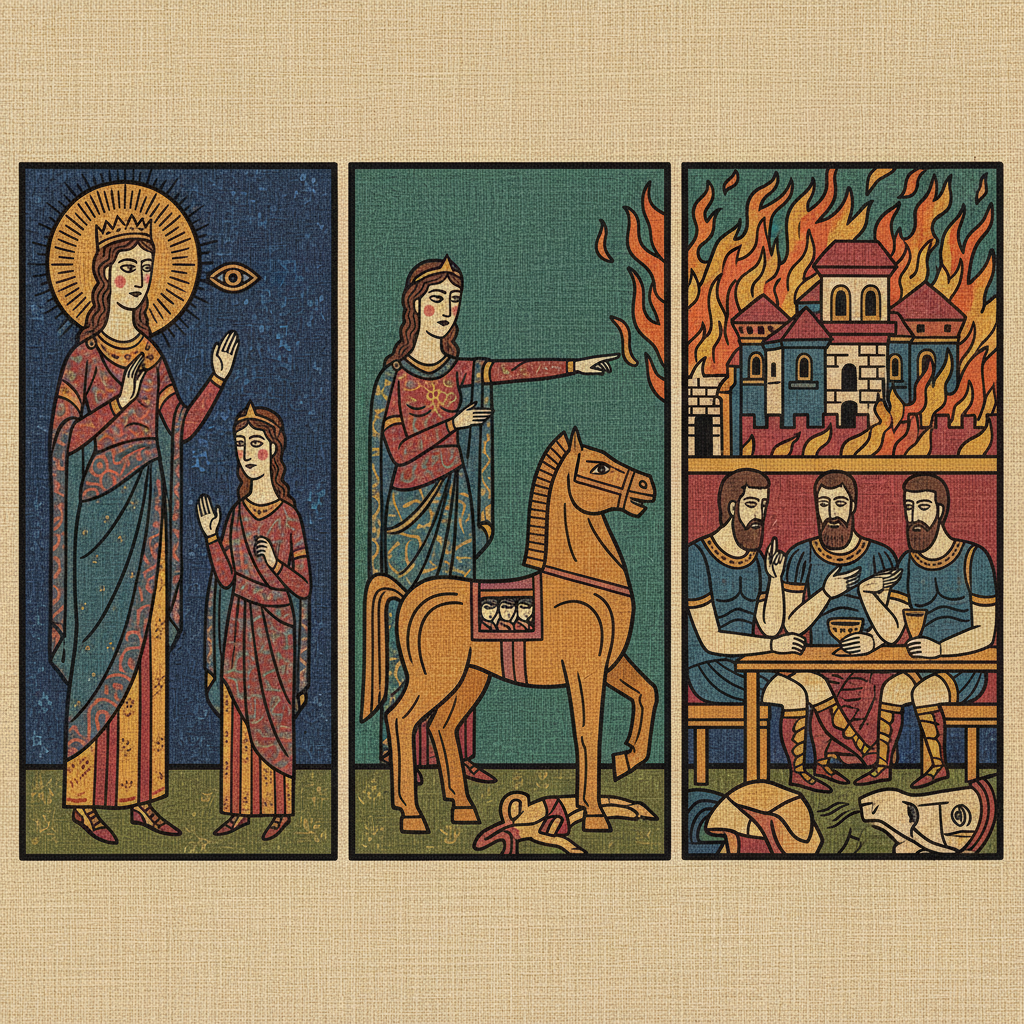 Image générée avec OGMAI — Style graphique : Tapisserie médiévale
Once upon a time, there was a princess of Troy of unparalleled beauty and a mind as sharp as the finest blade. Her name was Cassandra, which, in ancient Greek, means "she who helps men".
The gods had showered her with gifts: beauty, intelligence, sensitivity, empathy. Apollo himself, the insatiable sun god, courted her by offering her the gift of seeing the future. But Cassandra, human and free, was not charmed. Too much, it was too much. Too smooth, too beautiful, too strong, too brilliant. It hid something. Not natural, not human. Too much for her, as she preferred truth, the wounds of earthly life, and the joy of living before certain death. Apollo, not accustomed to having his advances refused, was humiliated and cursed her. Since he could not retain his dignity by taking back his gift—taking back is stealing, isn't it?—she would see the future, but no one would believe her.
And she saw the fall of Troy, described the fire, the corpses, the trapped horse, alerted and exhorted the leaders. They listened to her politely because she was a princess and quite pretty, but without real attention. What does a trophy, oops, what does a woman know about war? In doing so, they committed the outrage of forgetting Athena, the goddess of martial strategy. And it cost them dearly.
Her predictions proved true. Troy burned, was pillaged, men massacred, women raped, children imprisoned then enlisted in the victor's army like Turkish Janissaries.
From then on, Cassandra became the living ghost of anticipation: she had seen the fall of all-powerful Troy from the top of its ramparts. She had seen the traps in the gifts, the cracks in the walls.
She knew too much, was a disturbance, her lucidity provoking only embarrassment or sarcasm. The most astonishing thing is that this knowledge, far from saving her, condemned her to oblivion.
Cassandra is the tragic and oh-so-classic story of unheard intelligence, of a gift that has no place in society. One must above all respect the chain of command, or the "that’s how it’s always been done".
In the play "The Trojan War Will Not Take Place. It is in the hearts...", Jean Giraudoux shows well that even an exact prophecy is not enough to change the trajectory of a system that does not want to listen.